

Word error rate (WER)
WER counts the words in the transcript that differ from the words you typed. A word can be wrong, missing, or extra. The count is divided by the number of words you typed.- Range: 0 and up. 0 means every word matches. Lower is better.
- Every run measures it.
The second and third rows show the limit of WER. In the second row, “1” and “एक” mean the same thing, but WER counts it as a wrong word. In the third row, “दो” changes the question, yet its WER is lower.
Character error rate (CER)
CER works the same way as WER, but counts letters instead of words. A small change inside a long word costs less than with WER. This helps with Hindi and other Indian languages, where one long word can carry a lot of meaning.- Range: 0 and up. 0 means every letter matches. Lower is better.
- Every run measures it.
Meaning-based scores
These scores appear when Use built-in LLM-based evaluation metrics is on in the Evaluators tab of a new evaluation. It is on by default. An AI model reads each transcript next to the words you typed and judges the meaning.
In the WER table above, the second row would get an LLM-WER of 0, because “1” and “एक” mean the same thing. The third row still counts as an error, because “दो” changes the question.
Your own evaluators
You can also add evaluators that score each transcript in your own way. Click Add evaluators on the Evaluators tab of a new evaluation. Each evaluator gets its own column on the Leaderboard and Results tabs. See Create an evaluator.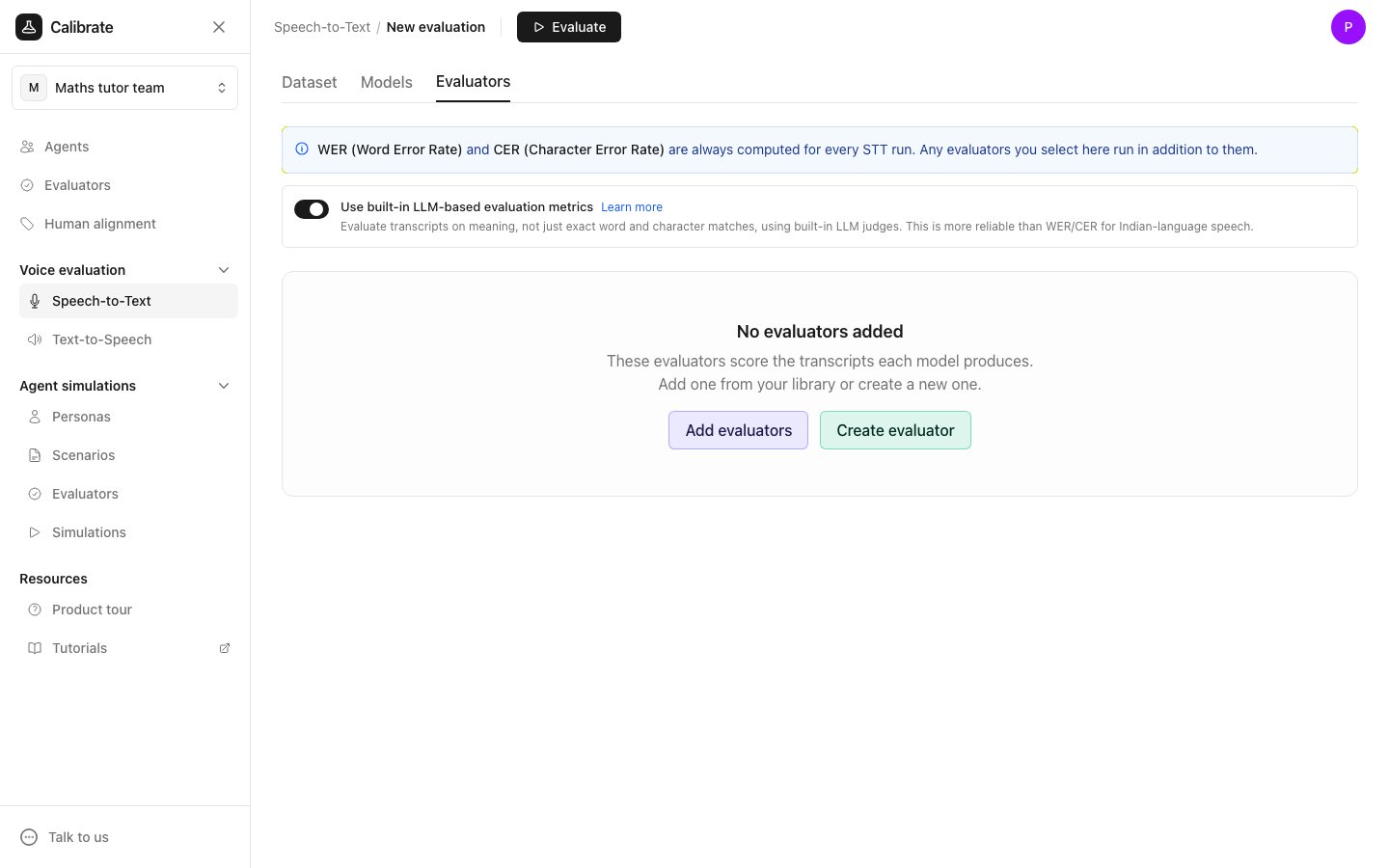
Next steps
Benchmark speech-to-text models
Run an evaluation on your recordings
Speech-to-text datasets
Create and manage the recordings you test with